Get your first sales conversations within 24 hours.
Turn warm conversations into sales calls. Without the awkward pitch.
You already have the people. The Permission Method shows you who to approach, what to say, and when to say, “Shall we talk?”
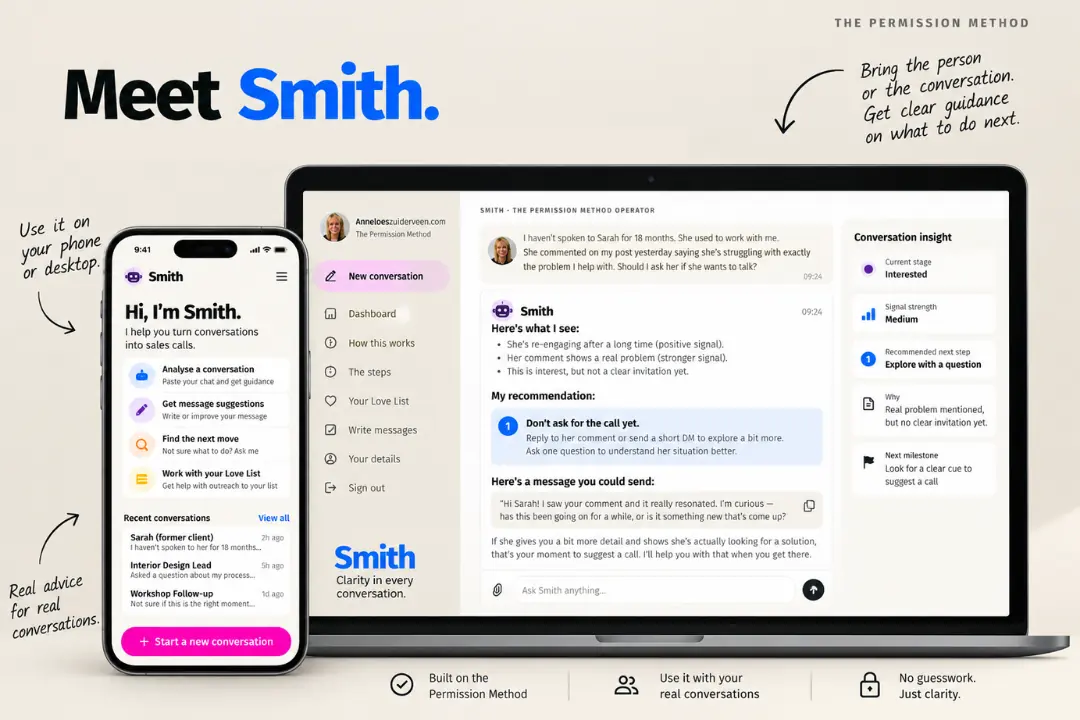
Use Smith to put the method into practice, helping you work out who to approach, what to say, how to respond, and when to make the ask.
GET SMITH €144One payment. No subscription. The Permission Method and all manuals are yours to keep forever. 90 days of Smith included. 7-day money-back guarantee. No ChatGPT, Claude or other AI subscription required.
What people sent me afterwards.
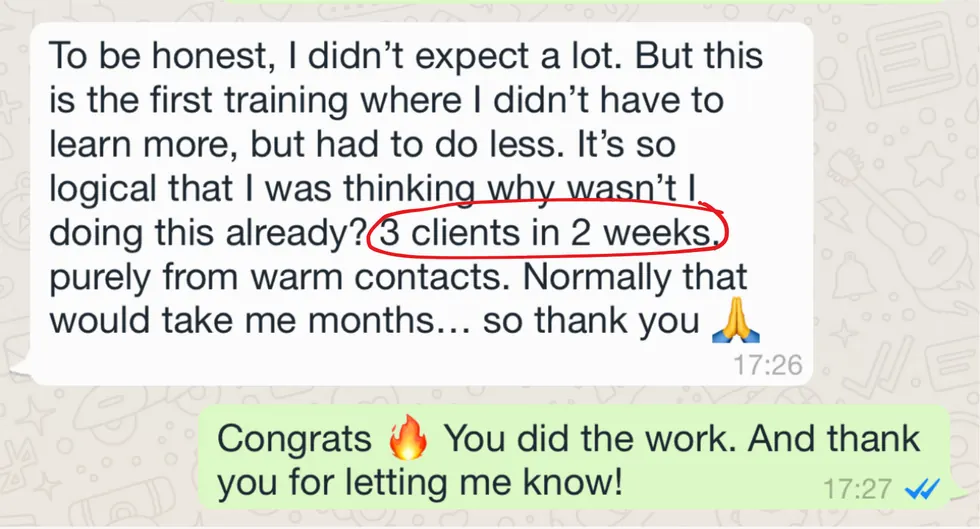
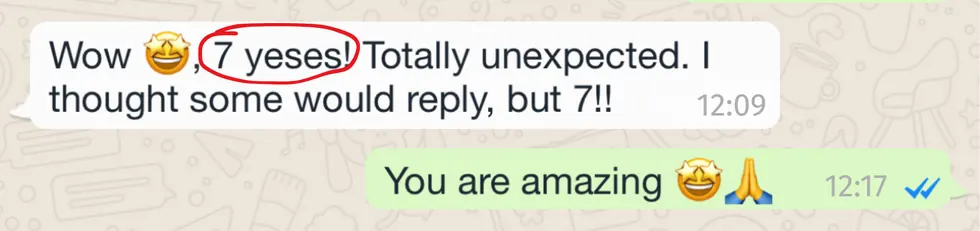
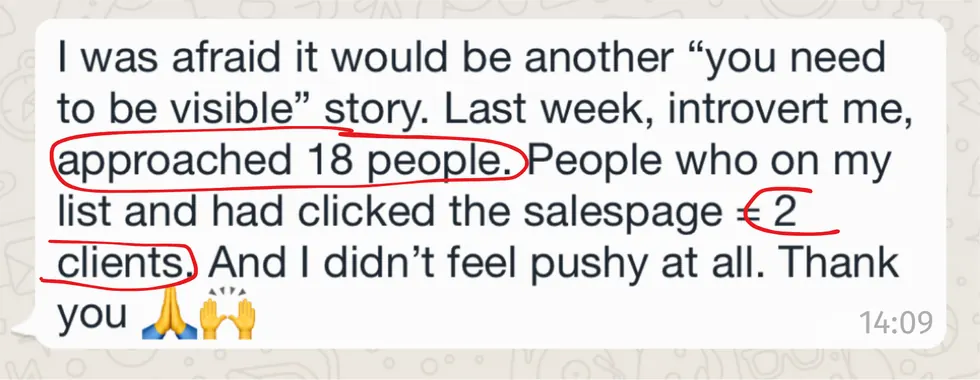
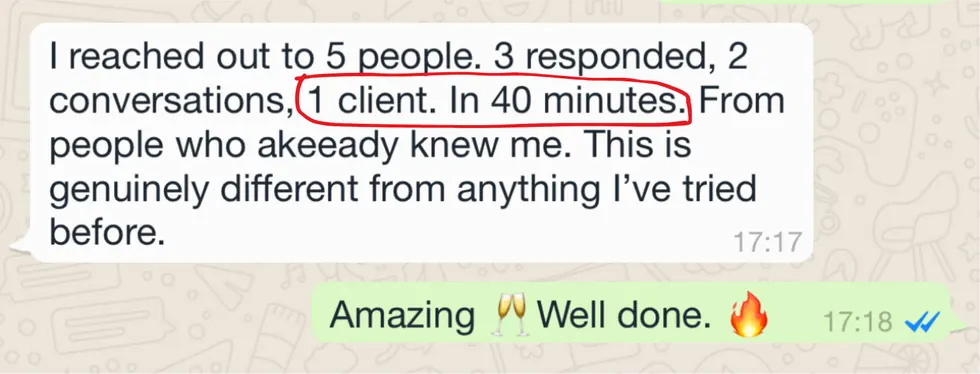
You know they're a fit. You know they need your help. You're just waiting for them to make the first move.
From the desk of Anneloes Zuiderveen
Re: the conversations that keep going nowhere
If you have a network full of people who could become clients, but somehow struggle to turn those relationships into sales calls, this is for you.
It doesn't matter whether you have 5, 50 people in your network or 500.
It doesn't matter whether people already know, like and trust you.
The same awkward moment keeps showing up.
You start talking.
They respond.
They tell you about something they're struggling with.
You know you could help.
And then you have to decide:
Do I ask?
That's where things get messy.
- You have a conversation with someone who clearly has a problem you solve, and you let the conversation die because you don't know whether it's the right moment to ask.
- Someone tells you, “I've actually been thinking about this for a while,” and you wonder whether that's a buying signal or just conversation.
- You think, I should probably suggest a call, then spend three days waiting for them to make the first move.
- You finally do ask, but it feels so abrupt that you immediately wonder whether you've just turned a genuine relationship into a sales pitch.
- You know exactly who you'd love to work with, but you keep approaching people who are easy to talk to rather than people who are actually ready to move.
- You have dozens of people in your network you've never approached because you don't know what the reason for starting the conversation should be.
- You use ChatGPT to write the message, read it back and think, “Jeeeee. I would never actually say this.”
- You get a reply and immediately start analysing it: Are they interested? Are they being polite? Should I ask? Should I wait?
- And because you can't reliably tell the difference, you either push too early or wait too long.
So you fall back on what feels safest.
Posting.
Networking.
Waiting for referrals.
Hoping someone will raise their hand.
Meanwhile, the people who could become your next clients are already sitting in your network.
One payment. No subscription. The Permission Method and all manuals are yours to keep forever. 90 days of Smith included. 7-day money-back guarantee. No ChatGPT, Claude or other AI subscription required.
The problem isn't starting conversations.
It's knowing which conversations to move forward, when to make the move, and how to do it without making it weird.
So I built Smith.
An AI sales agent trained on my Permission Method.
Smith helps you work out who to approach, what to say, how to respond, and when to make the ask.
You bring him the person.
You bring him the conversation.
He helps you decide what to do next. Keep talking, ask a question, or make the ask.
Because the goal isn't to have more conversations for the sake of having them.
The goal is to turn the right conversations into sales calls.
Smith does one thing: he helps you turn warm conversations into sales calls.
Smith is not a real person, he never speaks to your prospects, and he never sends anything either. He is my Permission Method wearing a name, so you have something to talk to at eleven at night when you are trying to work out who to talk to, what to say, and whether the conversation is ready to move forward.
Give Smith a person you're thinking about approaching, or paste in a conversation you're already having.
He helps you work out:
- Who to approach.
- What to say.
- How to respond.
- When to make the ask.
So you're not sitting there wondering:
“Is it too soon?”
“What do I say now?”
“Am I being too pushy?”
Smith tells you what the conversation is actually telling you, and what to do next.
He runs on the Permission Method, my system for turning warm conversations into sales calls without forcing the sale.
1
Who should I talk to?
Who in your network is actually worth approaching?
2
What do I say?
What's the natural reason to reach out to this particular person?
3
What does their reply mean?
What is this person actually signalling?
4
Is this the moment to ask?
Has this conversation earned the move to a sales call?
5
What do I say now?
What can you say that moves things forward without suddenly sounding like a salesperson?
The part no sales training teaches you. It's how to read the responses
Five things could be happening.
Only one means: ask.
Watch Smith decide which one you're looking at.
01
They're being polite.
“Oh, that's interesting. I'll have a look at your website sometime.”
Smith: Keep the conversation going. There isn't a reason to ask for a call yet.
02
They're curious.
“How does that actually work?”
Smith: Answer the question. They're exploring, not necessarily looking to buy.
03
They have a problem.
“I've actually been struggling with this for months.”
Smith: Now there's something worth exploring. Ask a question before you suggest a call.
04
They're interested.
“This is exactly what I've been trying to figure out.”
Smith: You've got a clear cue. Ask one more question before you suggest a call. Here's what I'd say:
05
They're ready.
“Honestly, I think I need help with this.”
Smith: Ask.
“Want to jump on a call and look at it together?”
The difference is tiny. The next move isn't.
You don't need to become better at reading people by instinct.
You need a way to recognise what the conversation is telling you.
That's what Smith does.
So how does Smith know what to do?
Because he's trained on my Permission Method.
I've spent 20+ years watching, testing and refining what makes someone move from “I'm interested” to “Let's talk.”
The Permission Method is the system I've built from that experience.
It gives Smith a framework for reading what's actually happening in a conversation:
- They're just chatting.
- They're showing genuine interest.
- They've given you something worth exploring.
- They've given you permission to ask for the call.
And Smith applies that thinking to your actual conversations.
You give him the person or the conversation.
He helps you understand what you're seeing, what it means, and what to do next.
The AI does the processing. The thinking comes from me.
See Smith in action.
Here's what happens when you give him a real conversation.
You bring the person.
You bring the conversation.
Smith reads the conversation, spots the cue, and tells you what to do next.
Demo 1
What should you say next?
When someone is interested, yet timing is getting in the way, the right response depends on what they actually said.
Here's what Smith does with that conversation:
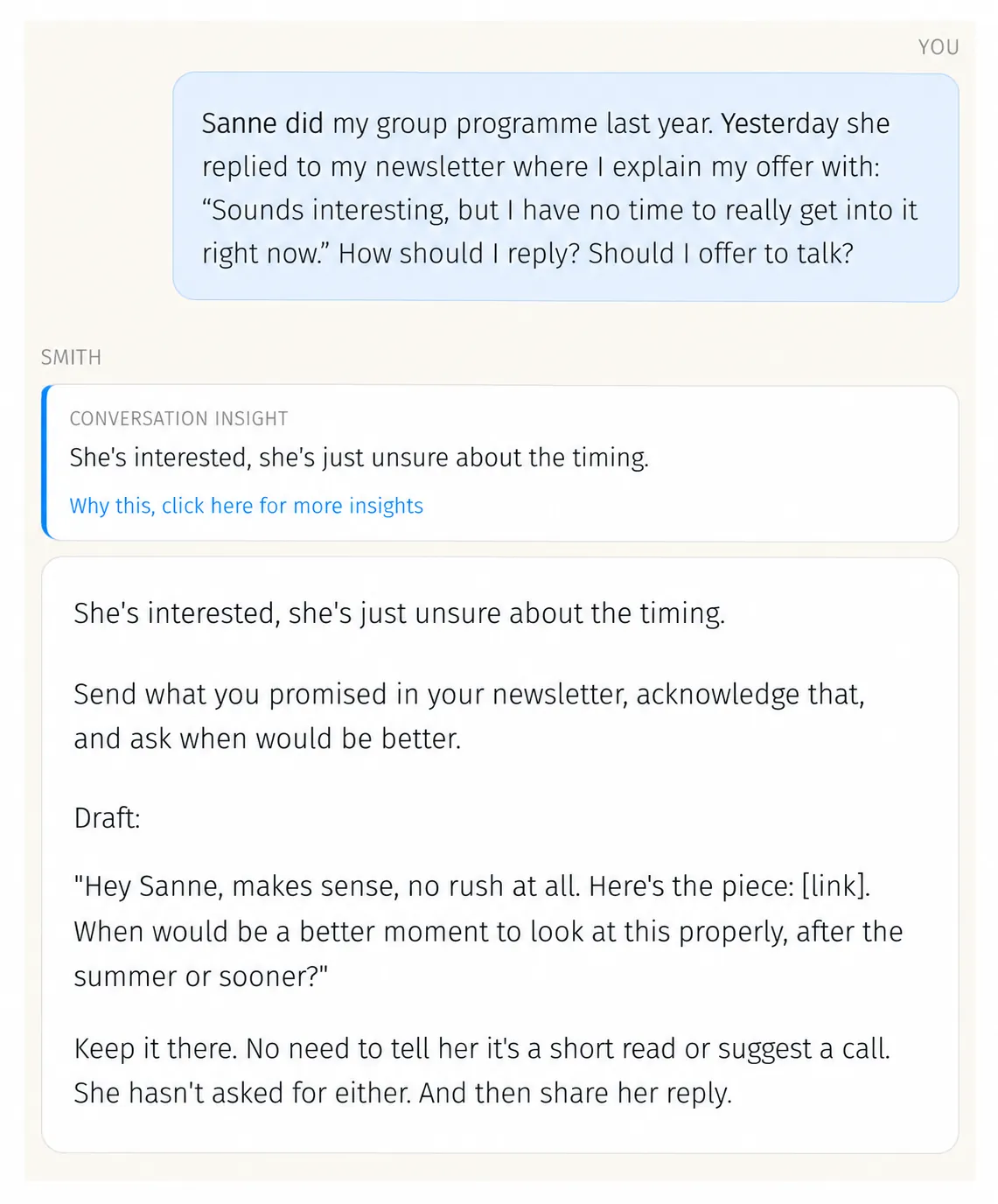
It identifies the situation first, then gives you the move.
Sanne is interested. Her hesitation is timing. Smith doesn't try to overcome it. It tells you what to send and why.
Demo 2
Should you ask for a call?
Sometimes the best sales move is to create less momentum, not more.
Watch what Smith does with this conversation:
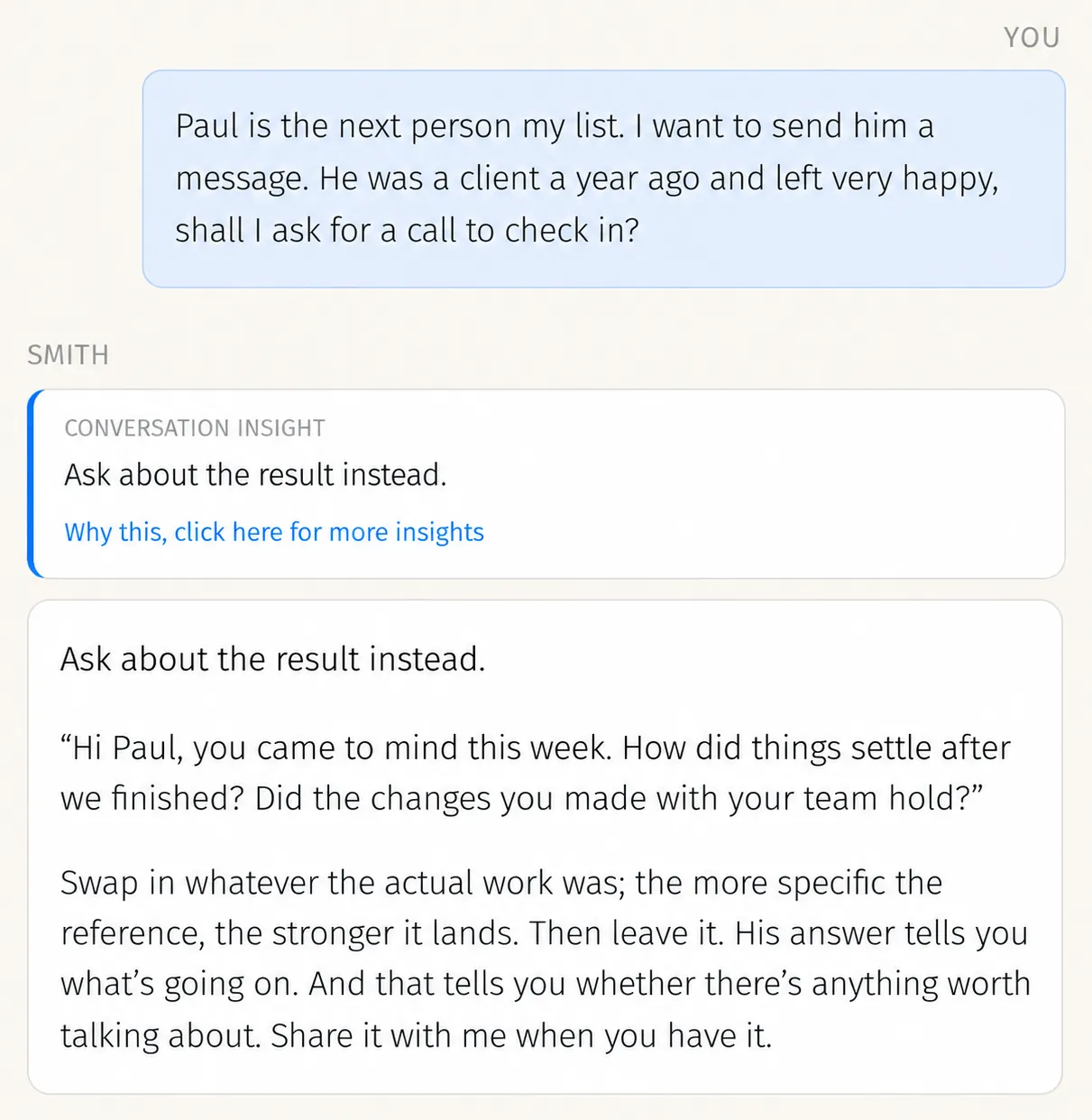
It doesn't automatically follow your instruction. It reads the situation.
Paul already knows you and had a good experience. Smith sees that a call is premature and gives you a better opening: ask about the result of the work.
You still have the conversation. Smith simply helps you see what's happening inside it.
GET SMITH AND SEND YOUR FIRST MESSAGE TODAY €144One payment. No subscription. The Permission Method and all manuals are yours to keep forever. 90 days of Smith included. 7-day money-back guarantee. No ChatGPT, Claude or other AI subscription required.
Here's what happens when you just ask ChatGPT
You give both of them the exact same situation:
“I haven't spoken to Sarah for 18 months. She used to work with me. She commented on my post yesterday saying she's struggling with exactly the problem I help with. Should I ask her if she wants to talk?”
Plain ChatGPT
ChatGPT sees a request for a message.
So it gives you one.
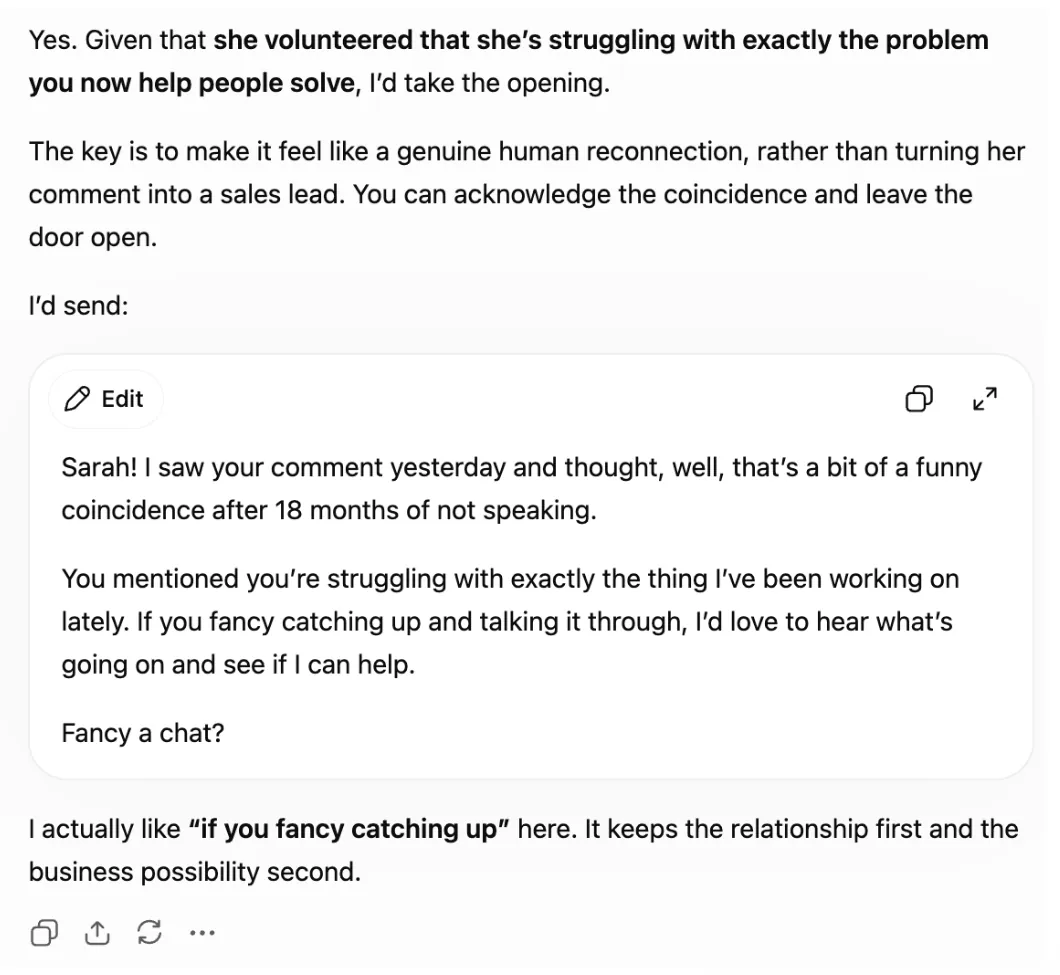
It'll probably sound perfectly reasonable.
But it hasn't really answered the question:
Should you ask Sarah for a call right now?
Smith
Smith looks at the situation differently.
He looks at Sarah, your relationship, what she said, the timing, and the cue she's given you.
And in this case?
He tells you to hold off.
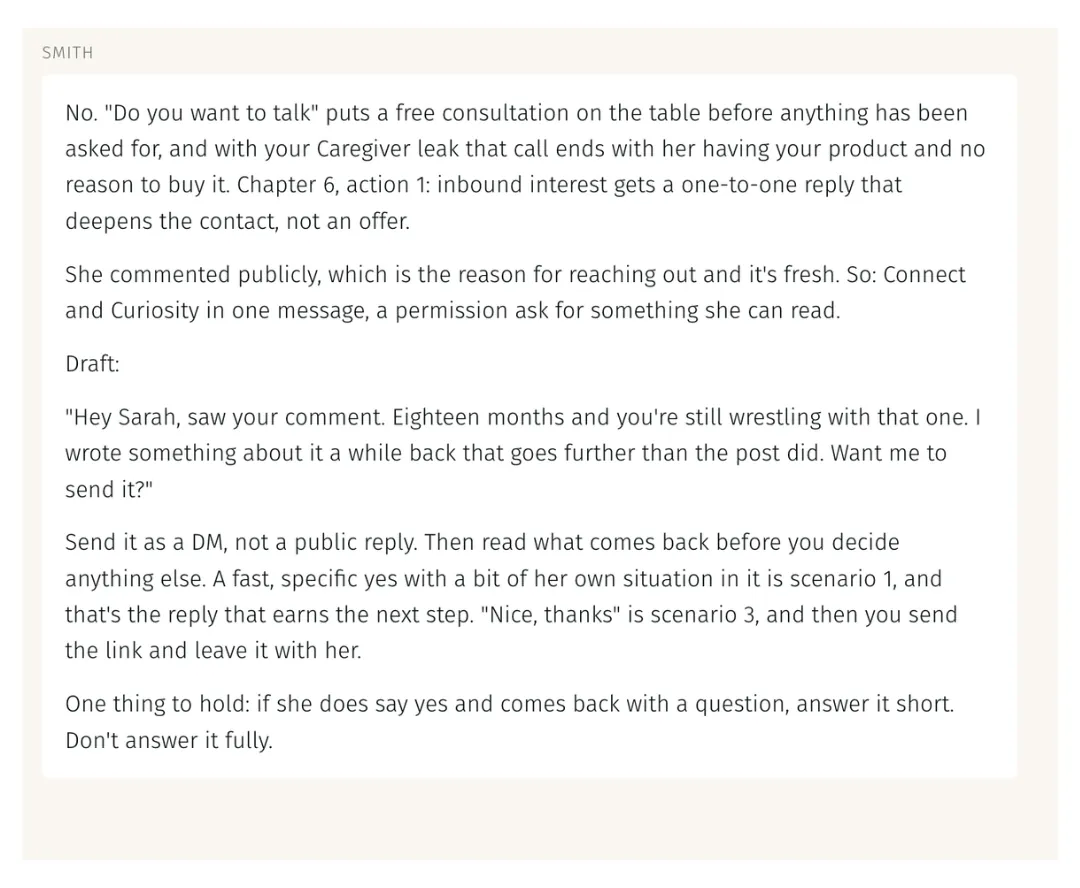
Instead of jumping straight to:
“Fancy a chat?”
Smith tells you what to do first and why.
That's the difference.
ChatGPT helps you write the message.
Smith helps you decide whether it's the right message to send at all.
Which one do you think gets you closer to a client?
One payment, no subscription
The guessing way vs the Permission Method
The old way
The Guessing Way
- Think of someone.
- Wonder if it's weird to contact them.
- Write a message.
- Rewrite the message.
- Send it.
- Wait.
- Get a vague reply.
- Wonder what the hell it means.
- Wait some more.
- Decide warm outreach doesn't work.
The new way
The Permission Method
- Message someone you already have a reason to contact.
- Start a normal conversation.
- See how they respond.
- Use their response to decide what to say next.
- Keep the conversation going.
- Ask when it makes sense.
- Have the sales call.
You don't need more confidence. You need a way to know what to do next.
Where this comes from
Smith is new. The thinking inside him isn't.
These results come from people who ran the Permission Method for 90 days in spring 2026 — posting their weekly numbers as they went. The difference: they had a group to report to and worked from the written guide. You'll have an interactive app guiding you all the way through.
From the first 4 weeks
From the Friday check-ins
of the 90-day Permission Method run
Every Friday, they posted three numbers: contacts made, replies received, conversations had. No story, just the count. Everyone quoted here agreed to be quoted.
The numbers are small on purpose. Nobody messaged a hundred people. Seven conversations with the right names beats seventy with the wrong ones.
Week 1
Ilse Verhoef
hairdresser with a training facility for hairdressers, Netherlands
Contacts
7
Replies
7
Conversations
6
of which 1 booking for a 3-day program, and 1 sign-up for a day training, 1 definite not-now-but-later, 3 ongoing
Week 2
Harriet Robijn
visual facilitator, Netherlands
Contacts
20
Replies
7
Conversations
4
2 assignments
Week 3
Daphne Bos
energy worker and coach, Netherlands
Contacts
6
Replies
5
Conversations
7
Week 4
Martijn de Loor
executive coach for boards, Netherlands
Contacts
8
Replies
8
Conversations
6
“Not only with the Permission Method; there's more life in the whole thing. Got a spontaneous sign-up too.”
Martijn in week 4
The whole group, same four weeks · 10 people
201
Contacts
111
Replies
97
Conversations
Smith didn't invent the method. He makes it usable.
I built this because I was tired of watching good people make sales harder than they needed to be.
I see experienced business owners miss so many clients they could genuinely help.
They have the network. They have the expertise. They have the conversations.
They just don't know when to make the move.
So they wait, hesitate, or leave a perfectly good conversation hanging.
The Permission Method was built to change that.
And Smith helps you learn to see the moment when a conversation is ready to move forward.
The system
Everything you need to master the Permission Method
You get 90 days of Smith. The method is yours forever.
Smith
Your AI sales agent for 90 days.
The interactive app you work in every day. Bring him a person or a conversation, and he tells you who to approach, what to say, how to respond, and when to make the ask.
Up to 60 Smith answers every week while you build the skill and work through your real conversations.
Everything that makes the method work
The Permission Method
The five phases, decisions, examples, messages, response patterns and next moves Smith uses to guide you through a conversation.
Network Activation Guide
A practical guide for keeping your network full of the right people to have conversations with, and creating a steady flow of new people into your world.
Love List
The 15-min. exercise that turns the people already around you into a concrete list of people worth talking to.
The Before-You-Send Checklist
Your one-page check before you send. Is this the right person? Is this the right moment? Are you moving the conversation forward with permission?
The Reaction Interpretation Table
A quick reference for understanding what different responses actually signal about someone’s readiness and what to do next.
The 30-Day Activation Tracker
Track who you contacted, what they said, where each conversation stands and what happens next.
Making the Method Stick
The 30-day habit lock that takes you from your first conversations to a repeatable sales rhythm. So you actually use the damn thing.
One payment of €144. Everything opens the moment you join.
Why 90 days of Smith?
Days 1–30
Use Smith
Days 31–60
Start seeing the patterns
Days 61–90
Start seeing them yourself
That's deliberate. The goal isn't to have an AI make these decisions for you forever. The goal is to learn to see the cues yourself.
The first 30 days are usually the most intensive. You use Smith frequently, test the method, see different responses and learn what each cue means.
Then something starts to happen. You start spotting the patterns before you need to ask Smith. You recognise the difference between someone being polite, curious, interested or actually ready to talk. You start knowing when to keep the conversation going, when to ask another question, and when it's time to say: “Shall we talk?”
By 90 days, you are seeing things you used to miss.
Smith becomes the training partner that helps you build the skill, rather than something you need forever.
What this is, and what it is not
This is
- An AI sales agent that helps you turn warm relationships into sales calls. Smith helps you decide who to approach, what to say, how to respond, and when to make the ask.
- The complete Permission Method, built into the app. You learn the thinking behind the method while Smith helps you use it.
- An interactive system, not a pile of information. You always know who you're working on, where the conversation stands, and what to do next.
- Your complete set of implementation tools. The Network Activation Guide, Operational Manual, Sales Checklist, Love List, Reaction Interpretation Table, 30-Day Activation Tracker and Making the Method Stick.
- Smith for 90 days. Use him with the people you're approaching and the conversations you're having. Extend when you want to keep using him.
- €144 once. No monthly subscription for the method or app. Smith is included for 90 days.
This is not
- Another sales course you're supposed to finish before you can use it.
- A prompt pack you have to figure out yourself.
- Generic ChatGPT with a few sales prompts thrown at it.
- An automated outreach bot sending messages to strangers on your behalf.
- A sales script that tells you to push everyone towards a call.
- A promise of clients, revenue or guaranteed sales calls.
€144. That's it.
No monthly AI subscription.
No advertising budget.
No funnel to build.
No campaign to manage.
More conversations.
More sales calls.
More clients.
Using the people you already know.
You don’t need another complicated marketing machine. You need to know who to approach, what to say, and when to make the ask.
GET SMITH €144One payment. No subscription.
The Permission Method and all manuals are yours to keep forever.
90 days of Smith included.
7-day money-back guarantee.
No ChatGPT, Claude or other AI subscription required.
7 days to try it properly
Try Smith. Use the method. Start the conversations. See what happens.
Open it, build your list, send your first messages. If within seven days you decide this is not for you, email me and I'll refund you. No form to fill in.
After that the 90 days of Smith are yours to use.
GET SMITH €144One payment. No subscription. The Permission Method and all manuals are yours to keep forever. 90 days of Smith included. 7-day money-back guarantee. No ChatGPT, Claude or other AI subscription required.
Questions people actually ask
Will it sound like me?
That's the whole point of Smith. Before he writes anything, he reads a few messages you've actually sent and works from those. Not from a template. Not from how AI thinks you write. From you.
You still get a draft, not a finished message. Read it out loud. If a sentence isn't how you'd say it, change it. If you find yourself rewriting every line, tell him, and the next one comes back closer.
The person you're sending it to knows you. If it didn't sound like you, they'd notice. So would you.
Why is Smith included for 90 days?
Because the goal is to learn the skill, not depend on Smith forever.
The first 30 days are usually the most intensive. By 90 days, you should be spotting the difference between “they're being polite” and “this person actually wants to talk” without needing Smith to tell you.
Want to keep Smith? You can extend your access.
The Permission Method and all accompanying documentation are yours forever and can be downloaded and kept.
How much can I use Smith?
You get up to 60 Smith answers every week for your 90-day access.
That's plenty of room to work through your real conversations while you're learning the method.
Can I extend my access?
Yes. If you want to keep Smith as your sales agent, you can extend your access after the first 90 days.
Do the messages get sent for me?
No. You send every message yourself, to someone who knows you, through whatever channel you normally use with that person. Email, WhatsApp, LinkedIn, Instagram. Use the one you'd use anyway.
Do I need to know anything about sales first?
No. The people whose numbers you see above are a piano teacher, a hairdresser, an energy worker and a visual facilitator. None of them had sales training. At each step, Smith tells you what to do next. So you're never sitting in front of a blank screen deciding what selling looks like.
It works the other way round too. Plenty of people using this have sold for twenty years and are good at it. What they don't have is a way of working out who to talk to and when to ask.
Will this work on my network?
Absolutely. It works on people who already know you. Past clients, people you worked with, contacts from earlier jobs, followers who reply to things. Most people have more names sitting in their phone, inbox and LinkedIn than they realise. That's what the Love List is for. Even when you feel awkward contacting them.
If you are genuinely starting from nothing, The Network Activation Guide covers building the inflow, and it is included.
Where it does not work: if the only people who know you are people you will never sell anything to. That is a positioning problem, not a conversion problem, and this will not fix it.
I have not spoken to these people in ages. Is it not strange to reach out now?
It is awkward for you, not for them.
Most people are glad to hear from someone after a silence, as long as there is an actual reason and you do not open with a pitch. That is where it usually goes wrong. Chapter one is about that exact message, and how to break an eighteen-month silence so it reads as normal rather than transactional.
Is this going to tell me to slide into DMs?
No. Smith isn't going to tell you to send a stranger a cheesy pitch because they liked your post. Permission-based means you ask before you pitch and you stop when the answer is no. The Cues chapter exists so you can tell the difference between someone who wants to hear from you and someone being polite. Most outreach advice skips that step, which is why it feels grim at both ends.
You will send messages. They go to people who know you, with a real reason, and with no agenda buried in the second paragraph.
One exception worth knowing: when someone sends you a connection request on LinkedIn, he helps you reply in a way that reads interested, not salesy. That's the one cold moment it does cover.
Do I keep the Permission Method materials?
Yes. Everything except Smith is yours to keep.
You get lifetime access to the Permission Method, the manuals, guides, checklists, trackers and all the other materials included with your purchase.
Does it work in other languages?
Yes. If you talk to him in Dutch, Smith will answer in Dutch. He can work in most other languages too.
P.S. If you skipped everything above, here's the whole thing.
You already know people who could become clients.
The problem is knowing who to approach, what to say, what their response means, and when you've earned the right to ask for the call.
The Permission Method gives you the system. Smith helps you use it on the actual people and conversations in front of you.
Use him on your real conversations.
Learn to see the cues yourself.
Then go have the sales calls.
You get the complete method, the interactive app, all the implementation tools and 90 days of Smith for €144.
You could start with one person today.
Get Smith for €144 TODAYOne payment. No subscription. The Permission Method and all manuals are yours to keep forever. 90 days of Smith included. 7-day money-back guarantee. No ChatGPT, Claude or other AI subscription required.
Smith + the Permission Method · €144 once
Get Smith